


 MX
MX
 US
US


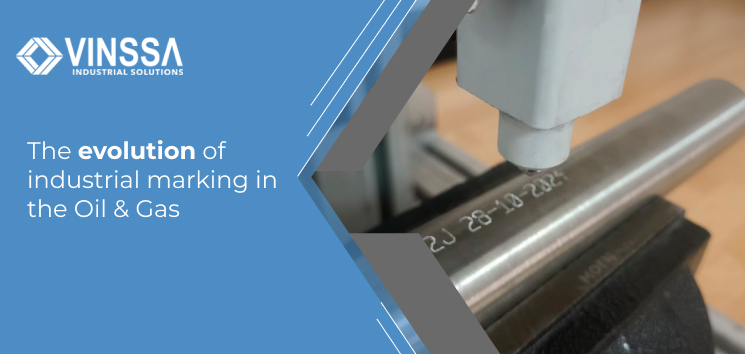
The evolution of industrial marking in the Oil & Gas
Oct 22, 2025 By: José Juan Aguillón
The oil and gas sector is undergoing a profound transformation, driven by the need to improve operational efficiency, ensure asset security, and meet sustainability goals.
The evolution of industrial marking in this sector has shifted from traditional methods to digital identification and advanced monitoring solutions, integrating multiple technologies.
How marking technologies integrate with EAM/CMMS systems in the Oil & Gas Industry?
Marking technologies assign each component a unique identifier (data matrix, UID, serial number, etc.) that can be read by equipment (mobile readers, cameras, etc.) and sent to the EAM/CMMS to create or update asset records, issue work orders, record inspections and support traceability, and audits. The control and monitoring of this information are centralized through specialized software.
Computerized Maintenance Management Systems (CMMS) and Enterprise Asset Management Systems (EAMS) are platforms designed to manage maintenance scheduling, work order tracking, inventory, control, and regulatory compliance.
In the Oil & Gas industry, this integration provides significant benefits:
- Traceability in the event of failures and recalls
- Reduction of errors in manual entries
- Improved compliance with preventive maintenance, audits requirements, etc.
Best practices for implementation:
- Define the data model within the EAM
- Select the appropriate technology according to the use case and environment: Marking system: Pinstamp or laser. Marking type: DataMatrix, alphanumeric code
- Conduct field testing to validate readability under different environments tal conditions: corrosion, temperatures, etc.
- Offline strategy and synchronization: Devices must save readings
- Adherence to standards: Industry traceability practices for interoperability with suppliers and customers.
How does IoT help optimize operations in the oil and gas industry?
A major transformation in industrial marking and asset management is the adoption of the Internet of Things (IoT), which converts physical assets into connected data points that can be “marked” and monitored in real time. Industrial IoT links sensors, equipment, valves, platforms, pipelines, and tanks to a network that collects and transmits data in real time to platforms such as SCADA, MES, and EAM. This data enables continuous monitoring, predictive insights, and automation of decisions that once relied on manual inspections.
Across the oil and gas value chain- from exploration to distribution- companies area investing heavily in industrial loT. This digital sensorization enables:
1- Remote and continuous monitoring: Wireless industrial sensors certified for hazardous environments transmit critical data such as data such as pressure, temperature, vibration, or the presence of harmful gases in wells, heads, ducts, and refineries. Parameters like tank levels, pipeline flows, leaks, and pressures are monitored, allowing equipment to be supervised without the constant on-site personnel. This reduces travel, enhances safety, and enables faster response to incidents.
2- Predictive maintenance: Focuses on detecting potential equipment failures and defects, such as vibration, pressure, or thermography analysis. Predictive maintenance platforms based on AI and machine learning analyze this data in real time to anticipate failures in critical equipment or alert to abnormal conditions. Integrated with EAM/CMMS systems, they can automatically generate work orders and schedule maintenance only when necessary, resulting in fewer unscheduled failures and greater equipment availability.
What is blockchain technology in traceability in the oil and gas industry?
Blockchain technology plays a fundamental role in enabling transformation and improving traceability in the oil and gas industry.
The key features that make it valuable for traceability include:
- Immutability: Once data is recorded on the blockchain, it cannot be altered. This ensures a reliable, real-time data source that enhances operational control and decision-marking.
- Transparency and security: Blockchain provides end-to-end visibility and secure data traceability. By streamlining the exchange of critical information across the value chain, it helps reduce risks such as fraud, human error, data loss, and transactional discrepancies.
- Asset registration: The technology can record and track both tangible and intangible assets, ensuring complete visibility of all operations and transactions..
In the oil and gas sector, blockchain's greatest impact lies in supply chain optimization. It enables tracking of oil and gas from extraction to final sale. Given the complexity and high regulatory demands of this supply chain, where multiple stakeholders are involved, blockchain allows all parties to access a single, verified source of truth where every transaction and movement is recorded, ensuring complete traceability.
Blockchain technology serves as a bridge to greater operational efficiency and cost reduction, transparency, and security across the entire oil and gas value chain through its decentralized and immutable infrastructure.
What is digital twin technology in oil and gas industry traceability?
Digital Twin technology is one of the key enablers of digital transformation of the oil and gas industry. In the context of traceability and asset management, it converts physical assets into dynamic virtual models that mirror their condition in real time and throughout their entire life cycle.
A Digital Twin serves as a virtual replica of a physical asset in operation whether a well, pump, platform, or even an entire plant. This digital model is continuously updated with real-time data from IoT sensors, historical records, 3D models, and advanced analytics. It provides a comprehensive view of an asset’s status, performance, and history, as well as predictive insights under various scenarios.
In terms of traceability, the Digital Twin enhances visibility by recording and visualizing the complete life cycle of an asset, so that every change in the physical asset is synchronized with its digital twin, allowing stakeholders to know what happened, when, how, and why.
The adoption of Digital Twin technology is particularly crucial, as oil and gas operations, which are capital-intensive and often carried out in remote or high-risk environments. With this approach, traceability evolves from being a static record of data into a living, intelligent ecosystem of interconnected information.
Applications of Digital Twins in the Sector:
- Predictive maintenance: Enables early diagnostics and performance optimization through continuous monitoring of the performance twin.
- Downstream operations (refining): Used to simulate the behavior of process units or networks of service stations..
- Critical equipment monitoring: In offshore environments, Digital Twins are applied to rotating equipment and electrical instrumentation and control systems to facilitate condition-based maintenance.
- Design optimization: Data-driven insights allow engineers to refine designs and prioritize serviceability and reliability from the equipment.
Integration with other technologies
- Industrial Marking: Physically identifies assets. Each marked component (Datamatrix, RFID, or QR) can be linked with its digital twin.
- IoT: Provides real-time operational data into the twin for accurate modeling.
- Blockchain Ensures: Traceability data is verified, tamper-proof, and viewable within the twin. Ensures integrity and immutability.
- AI/Machine Learning: Predicts failures , enhances analytics, and optimizes twin parameters.
- EAM/CMMS: Integrates maintenance management, automatically generating work orders linked to the twin.
At VINSSA , we go beyond equipment supply, we integrate TELESIS marking technology with automated systems such as robots, PLCs, sensors, and industrial vision systems, providing customized solutions that enhance traceability , ensure precise and durable part identification, and optimize automation and productivity across your production processes.
Contact us if you'd like to learn more about our solutions for your industry.
 844 797 5478
 sales@vinssa.com
Or we invite you to write us a message
Contact us


